Quick Poll Results: Current Practice Patterns in Managing Chronic TMD-Related Pain

Author: Dr. Rahma Mungia
Introduction
Chronic pain related to temporomandibular disorders (TMDs) is a familiar clinical challenge that can affect jaw function, daily activities, and quality of life. Management may include patient education and self-management, intraoral appliances, medications, physical therapy, behavioral approaches, and coordination with other health care professionals.
The National Dental Practice-Based Research Network Quick Poll asked practitioners how often they see adults with chronic TMD-related pain; which approaches they recommend; how they view patient education and self-management; how often they coordinate care with other providers; and whether they would participate in future practice-based research. A total of 297 dental providers completed the poll. These findings offer a preliminary snapshot of chronic TMD-related pain management among responding Network practitioners and point to important questions for future research.
Key Highlights
- 75% of respondents reported seeing adults with chronic TMD-related pain at least several times per month.
- 78% considered patient education and self-management either essential or very important to treatment.
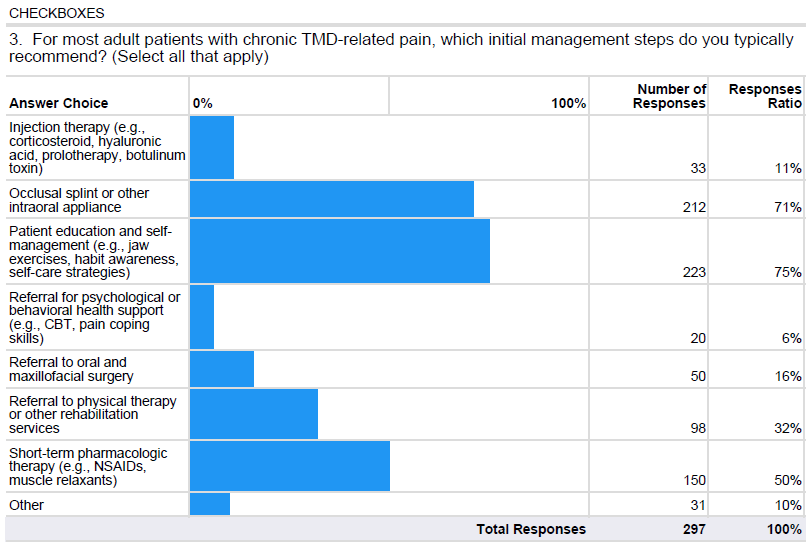
- The most commonly reported initial management approaches were patient education and self-management (75%) and occlusal splints or other intraoral appliances (71%).
- About half of respondents (51%) reported recommending short-term pharmacologic therapy, while 33% reported referring patients to physical therapy or other rehabilitation services.
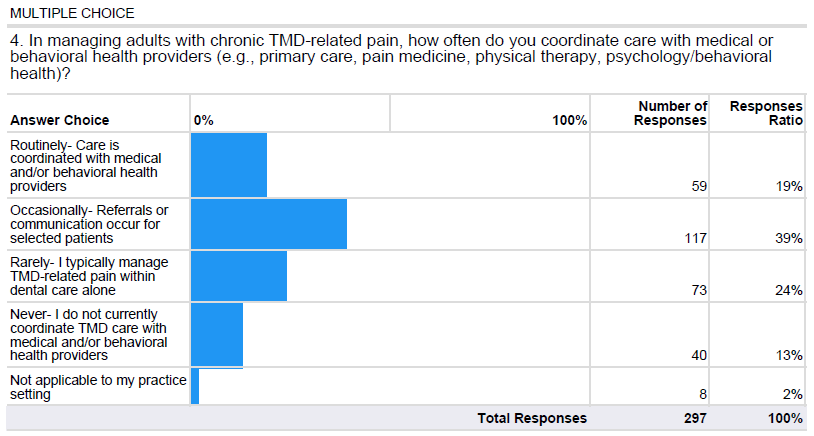
- 58% reported routinely or occasionally coordinating care with medical or behavioral health providers; 37% reported doing so rarely or never.
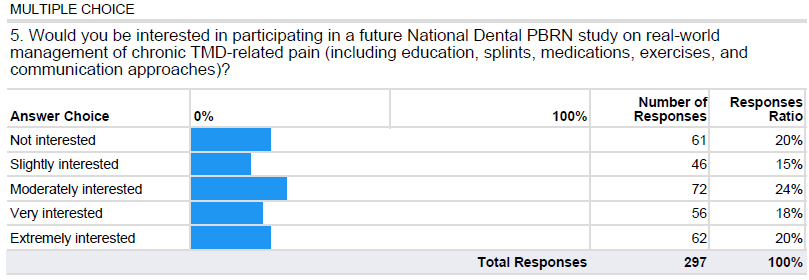
- 62% were moderately, very, or extremely interested in participating in a future Network study of real-world chronic TMD-related pain management.
Chronic TMD-Related Pain Is a Regular Part of Practice
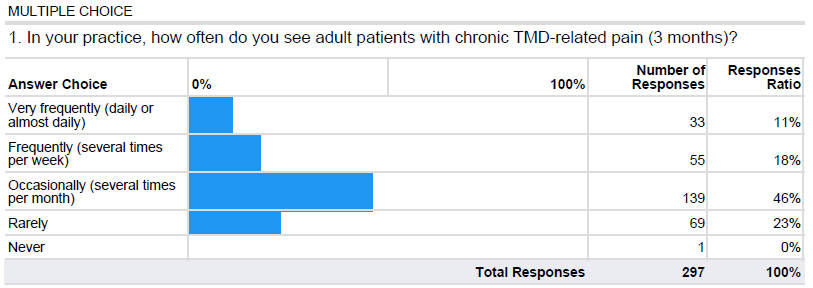
Most responding practitioners reported seeing adults with chronic TMD-related pain in their practices. Eleven percent saw these patients daily or almost daily, 18% saw them several times per week, and 46% saw them several times per month. Another 23% reported seeing them rarely.
Together, these findings show that approximately three in four respondents encounter adults with chronic TMD-related pain at least several times each month. That frequency reinforces the value of understanding how practitioners assess, manage, and coordinate care for this patient population across real-world dental settings.
Education and Self-Management Anchor Initial Care
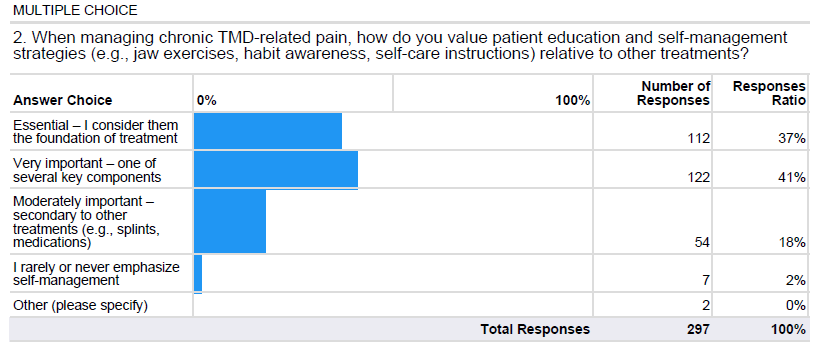
Respondents placed substantial value on patient education and self-management in chronic TMD care. Thirty-seven percent considered these strategies the foundation of treatment, while 41% described them as one of several key components. Eighteen percent viewed self-management as secondary to treatments such as splints or medications, and 2% said they rarely or never emphasized it.
This emphasis is also reflected in reported treatment choices. Patient education and self-management were the most frequently reported initial management approach, selected by 75% of respondents. The poll did not assess the specific content, format, or intensity of the self-management strategies practitioners provide, which remains an important area for future study.
Intraoral Appliances Remain a Common Initial Approach
Occlusal splints or other intraoral appliances were the second most commonly reported initial approach, selected by 71% of respondents. Short-term pharmacologic therapy followed at 51%, and 33% reported referring patients to physical therapy or other rehabilitation services.
Less frequently reported approaches included referral to oral and maxillofacial surgery (16%), injection therapy (11%), and psychological or behavioral health support (7%). Because respondents could select more than one option, these results reflect the range of strategies practitioners may use rather than a single treatment pathway.
The pattern suggests that responding practitioners often combine conservative, education-based care with appliance therapy and, when appropriate, medication or referral. Future Network research could help clarify how these approaches are sequenced, which patients receive them, and how outcomes vary across practice settings.
Care Coordination Varies Across Practices
Fifty-eight percent of respondents reported routinely or occasionally coordinating TMD care with medical or behavioral health providers. Specifically, 19% coordinated care routinely and 39% did so occasionally.
At the same time, 24% reported rarely coordinating care, 13% reported never doing so, and 2% said care coordination was not applicable to their practices. These differences may reflect variation in patient needs, referral availability, practice resources, and relationships with local medical, rehabilitation, and behavioral health professionals.
Understanding those factors could help the Network identify practical opportunities to strengthen interdisciplinary communication and referral pathways for patients with chronic TMD-related pain.
Practitioners See Value in Future TMD Research
Interest in future practice-based research was strong among poll respondents. Twenty percent reported being extremely interested in participating in a future National Dental Practice-Based Research Network study of chronic TMD-related pain management, while 18% were very interested and 24% were moderately interested.
Overall, 62% expressed at least moderate interest in participating. That level of engagement creates an important opportunity to study how chronic TMD-related pain is managed in routine care, including treatment effectiveness, patient-reported outcomes, referral patterns, and barriers to coordinated care.
What This Means for Our Network
These preliminary results confirm what many practitioners experience in daily practice: chronic TMD-related pain is a recurring clinical concern that often requires individualized management. Respondents reported relying most often on patient education, self-management, and intraoral appliances, while also using medications, rehabilitation referrals, and other approaches when clinically appropriate.
Your responses also identify meaningful opportunities for the Network to examine which strategies work best for which patients, how care coordination occurs in different settings, and how research can support more consistent, evidence-informed care. With 62% of respondents interested in future research, practitioners can help shape studies that reflect the realities of dental practice and improve care for patients with chronic TMD-related pain.
To explore other practitioner perspectives and Network research opportunities, visit the National Dental PBRN blog at www.nationaldentalpbrn.org/blog and learn how you can stay involved in future Quick Polls and studies.
See past Quick Polls
Click here to view a list of all of our past Quick Polls and their results.
Interested in Becoming a Member?
Related Posts